|
CATTERICK TO ARBORFIELD Contributed by: Fred WELLS (44A) Arborfield Army Technical
School (Boys). Sadly, Fred C. Wells was
recalled to H.Q. on the 29th of April 2020.
R.I.P. |
|
|
|
I was just 14 years and 22 days
old when I signed up on October 5th 1943 in Brighton, Sussex, but the whole
episode had started months before, after attending a medical examination in
Brighton and sitting education and aptitude tests, I was accepted for
Military Apprenticeship. October 5th 1943 dawned bright
and clear and the journey to the Brighton Recruitment office by train from
Chichester with my Mother was uneventful. Along with a motley collection
of other boys I formally declared my allegiance to King and Country, received
the King’s Shilling, signed my life away and was issued with travel warrants
to go to Catterick in Yorkshire. I was enrolled into the Royal
Corps of Signals as an apprentice Wireless and Line Operator. Mum was stunned. She had
expected me to go to Arborfield to be with my
Brother Bill who was training to be an Electrician. The Officer in charge explained
to her that my aptitude tests showed that I was more suited to Radio
operations than Electrical work and that at just 14 I was too young to go to Arborfield and that was all there was to it! I caught the 5 pm train from
Brighton Station to York, which should arrive at around 6 am the following
day. A true milk train! The journey went off OK. I had
some sandwiches and a flask of tea for the journey, and managed to hop off
the train at station stops to augment my supplies and with fitful sleep I
arrived at York on time. I cannot remember exactly if I was picked up at York
or whether I entrained to Richmond. Whatever the situation I, along with a few
other boys, was met at a station and taken to the Signal Boys Training
establishment. After a good breakfast, we were
allocated a room and bed space. I was in a room which housed about a dozen
beds in a brick building 3 stories high. I believe I was on the top floor. As
I was then the sole occupant, the other boys were to arrive later, I could
have my pick of the bed spaces. The door was at one end by the wall which
abutted the corridor. The opposite wall had the windows on it. Undecided what
to do I eventually took the bed space in the corner furthest from the door on
that side. It was a tossup between there and on the opposite side by the
window. I could see disadvantages to each place. On the corridor wall side I
would perhaps hear all the noise of people going along the corridor, on the
other hand being next to a window could perhaps be draughty if someone wanted
the window open for any reason as well as being noisy from outside
activities. My decision was proved to be
the correct one as time went on. My surmise about the window was proved to be
the right one, not only for the reasons given, but also because as soon as we
started our training boys would attach their Morse keypads to the Tannoy
system wires which ran on the outside of the wall just under the windows and
send Morse messages throughout the system. So on top of the disadvantages
detailed above, there would often be a lot of boys invading your space. The
practice was illegal of course and anyone caught could regret their actions
by being punished, but most boys tried it. The actual amount of corridor
noise was small as the walls were quite thick. A further advantage which I
had not thought of at the time, was that training staff entering the room to
find someone to do work, such as cleaning or cookhouse duties invariably
collared the boy whose bed space was directly in front of the door or someone
else on the window side. It became evident that they rarely looked at anyone
on the door side, especially right into the corner where my space was, so I
got away with a lot of fatigues. Within a few days the room
filled up and once the intake was complete we were kitted out with
battledress and the rest of our Army
kit, including our Royal Corps of Signals shoulder flashes which we had to
sew on using the supplied Housewife which was a small sewing kit containing
cotton, needles etc. Having had to mend socks and so on previously during my
many evacuee homes, I made a reasonable job of it, but most boys were not
used to doing that and it was quite hilarious to see the state of their
efforts on their tunics. One thing did surprise me
though was the fact that we had to `dubbin` our boots, not polish them. The
reason given was that Dubbin protected the leather better than polish, but
the result to my eyes was drab and dull. I thought that polished boots looked
better and I can’t say I went along with the `better for leather` idea. The
first day I had my new battledress, I was dubbining
my boots and had the open tin of dubbin on the bed. I can’t remember why but
I got up for some reason, probably to get to my second boot and promptly sat
down on the open dubbin tin. What a mess! I tried to wash it out but of
course it was grease like and resisted my efforts. The only recourse I had
was to take my trousers down to the Quartermasters Stores and ask for them to
be dry-cleaned. I must say that the Quartermaster was not amused considering
that I had only had the uniform a day! One of the first acts we had to
endure was having a haircut. No doubt to make sure that nobody had nits, all
our hair was cut off. We did look a sorry sight at first until it started to
grow again. We looked like a bunch of convicts. A couple of the boys were a
bit cocky to the barber and regretted it. One had a really close shave with
the shape of the union jack cut onto his head. He never lived it down.
Luckily we all had to wear forage caps, so it wasn’t noticeable normally,
only when back in our billet with hats off was it seen. Another day we went off to a
gas chamber to check on the effectiveness or otherwise of our issued gas
masks. These were different to the civilian types inasmuch as they had a
corrugated tube about 2 feet long from the headpiece terminating in a filter
box attached with tape to the waist. They were supposed to be more efficient
and I suppose for soldiers they were. Once attached and adjusted we all filed
into this gas chamber from one end and out of the other end after waiting
inside for about 5 minutes. It was obvious that some boys had not made sure
that their gas masks were on correctly by the coughs and gasps that were
evident. Once outside these unfortunate ones were made to correct their masks
and re-enter the chamber. Some lads had to endure this torture a few times
until they got it right. We certainly had a good laugh at their expense, but
the shoe was on the other foot at the end, as we who had been lucky were
ordered into the chamber without masks. We came out coughing and spluttering
to the taunts of those who had been unlucky previously. It was just as well
that the `gas` was said to be `safe`
but what is safe gas, even smoke is dangerous if inhaled long enough. The first few weeks were taken
up with learning to march in step with each other at the regulation pace. It
was amazing how many boys could not swing their arms correctly with their
legs. Trying too hard I think, because when they were walking naturally they
instinctively moved their arms correctly, but when marching they invariably
moved their left arm along with their left leg and their right arm with their
right leg and of course looked unbalanced. Eventually they got it right but
the poor old drill instructor would literally tear his hair out until then.
Of course all the shouting and swearing by him made matters worse as those
boys became more nervous. Sunday mornings was taken up
with Church Parade. Each religion was segregated and marched off to their
respective churches or chapels for services. Some of the places of worship were
some distance away, so it meant long marches there and back. Some religions,
notably the RC church also had religious instruction taking up the afternoon
as well, which was not very popular. During this time we were not
allowed out of barracks, but eventually after 6 weeks we were given the
opportunity to see outside our immediate premises. I decided to go to
Richmond on the bus to see what sort of town it was. I was pleasantly surprised to
find a typical country town with some of the streets still cobbled. Having
saved a couple of pounds from my 5 shillings a week pay including what I had
brought with me, I bought a Signals Corps dress forage cap which the
authorities allowed you to wear when off duty. It was dark blue with light
blue piping. Much better looking than the drab khaki ones. I wore it every
time I went out of barracks and was really proud of it. I saw in a jewellers shop
window in the town a clock which seemed to me to operate in perpetual motion.
It was enclosed in a glass cover and comprised an angled grooved plate onto
which a steel ball rolled from the top to the bottom within one minute. At
the bottom the plate was propelled upwards by a spring so that the ball
commenced it’s downward
journey once again, at the same time moving the minute hand of the clock dial
forward one minute. There did not appear to be any winding mechanism and I
was intrigued by it. Every time I went to Richmond I made a beeline to that
Jeweller to look at this fascinating clock. Many years later I was in the
vicinity of Richmond and again went to see if the clock was still there, but
sorry to say neither it nor the Jewellers was there, a totally different shop
occupied the space. I was very disappointed. Soon after we had all
assembled, it became apparent that although most boys were reasonably happy
to be away from home, there were one or two who were homesick. It was not
unexpected if it was the first time they had been separated from their
parents, and for most boys the feeling soon wore off once we had got into our
stride so to speak with our new Military duties. It didn’t worry me for
example. I had been away from my family since I was about 10 years old except
for the last 12 months when I returned to go to school in Chichester, so I
had got over the homesickness episode, but for two boys, twins, called Thomas
never got over the symptom. The first we realised that something was wrong
was when they had disappeared. Deserted in fact or A.W.O.L. (Absent Without
Leave) as the Army so delicately puts it. Within a couple of days they were
back, having been arrested at their home in Wales. The first time they went
AWOL they were reprimanded and confined to barracks for a week. The next time
they went AWOL and were returned, they received stiffer sentences. As well as
confined to barracks they also were detailed extra duties and fatigues. This
did not deter them, because time after time they left and were returned and
no detention or other punishment stopped them from disappearing. Finally,
they were deemed to be unfit for service and discharged. This of course meant
that other boys tried the same dodge, but most could not keep up the pace and
eventually everyone settled down and accepted that they were in service for
the next 12 years at least. The major part of our Trade
Training was to learn Morse Code by being able to read and eventually send it
using the supplied Morse Keypads. Initially we were all supplied with
headphones and listened to the Morse signals coming through them. Our first
surprise was that we were not expected to learn the codes in alphabetical
order, but what appeared to be a random order. For example we had to learn 5
letters at a time in the order; dit-da, dit-dit-da, dit-dit-dit-da,
and so on. These were played continuously to us and then in random order to
which we had to write down on message pads what each signal represented. Not
until ALL boys managed to write each signal as it was received accurately
over a number of sessions, did we go on to the next 5 letters, which were; da-dit, da-da-dit, da-da-da- dit. etc. Once again we had to learn it all perfectly. At the
end of that episode, you have guessed it, all the 10 codes were jumbled up
and transmitted until we were all word perfect. At the beginning it was hard
to get accustomed to the codes but after accomplishing the first 10 codes it
became much easier until everyone had picked up the ability to receive all 25
codes plus the numerals. Then the nitty gritty started. We had been
accustomed to receiving the codes at a leisurely pace. Once we had gained the
ability to read all codes, the codes were speeded up during receive.
Eventually of course everyone managed to read at the minimum of 16 words (the
average word being 5 letters) per minute, which was the accepted rate for
basic qualification. During all this of course we were also sending the
codes. At first slowly and then speeding up until 16 words per minute was
obtained. It was not all Technical
training though. We were also having educational schooling for the Army
Educational Certificates. There were in fact 4 grades. Army Certificate 3,
Certificate 2, Certificate 1 and a Special Certificate which was equal to the
then University Entrance Examination. We were studying for the certificate 1.
The argument being that because we had already passed a fairly stiff exam to
be accepted as a boy trainee that was equivalent to the class 2 certificate.
We studied English, Maths, Geography, Map Reading and Physics (Heat and
Light) The educational instructors were very good too. I always had trouble
understanding Maths, the subject always seemed to be akin to sorcery to me,
but within a couple of months tuition I was able to interpret Trigonometry as
well as Algebra, which to me was truly astounding. I was always reasonable at
Adding, Subtracting and Division, even Mental Arithmetic, but the other
subjects before this was a closed book. Now I gained more confidence. English
I found fairly easy, as was Geography, and Map Reading was fairly
straightforward. Physics was a bit harder but once I got over the maths bit I
found it to be reasonably straightforward. Wednesday afternoons were
always put aside for sports. At first I tried football but after breaking my
left forearm whilst acting as goalie in one match I gave that up!. I tried rugby but found that to be a bit rough going
for me, after all breaking an arm playing football, a relatively less
punishing game was enough, I didn’t want to risk breaking my neck or leg. I
was only a slight guy in those days, about 5 ft 2
inches and weighing about 6 stone. I eventually took to cross country
running. For two reasons, 1, that I liked it and 2, it got you away from the
barracks and you were on your own and free as a bird! I eventually joined a
Beagle Hunt where you ran with the dogs over the moors after hare. Whilst I
was with them I don’t think we ever caught a hare! On any cross country run you
had to be careful where you ran. On the moors around Catterick
were a fair number of missile ranges
which were clearly marked as such and of course you avoided them for obvious
reasons. There was one incident during a cross country run when one boy
decided to take a short cut back to camp across one of these ranges and trod
on an unexploded something or other and lost a leg. His Army career came to a
sharp conclusion. But it made one more careful in future. Along with trade training and
education, we also of course had to undergo Military training. This along
with square drill, marching, both normal time and slow time including
saluting, march past practice and countermarching. There was also weapon
training with .303 rifles (and they were heavy to us small soldiers) hand
guns, bren and sten guns.
We had to learn how to clean, load, dismantle and reassemble. Time was also
spent in firing the guns on the range to improve our accuracy in firing at
static and moving targets. Another aspect of the weapon training was bayonet
practice. Running with a .303 rifle with bayonet attached was a hazardous
occupation for all concerned, especially the boy with the rifle. It became
front heavy and when getting to the target, usually a straw filled sack
suspended from a gantry, and thrusting the bayonet at it with also emitting a
scream usually caused the boy to fall headlong into the ground. If in fact you
managed to enter the sack after the headlong dash, you often didn’t have the
energy to withdraw the bayonet from the straw filled sack, but subsided in a
sagging heap onto the ground. Mind you after a lot of practice and gradually
increasing strength the average boy managed the attack successfully, but it
was always a close thing. With ever increasing competence
in Morse recognition, training turned also to using and recognising other
means of communication, especially voice messaging and the various pieces of
equipment necessary for that job including what were then called type X
machines, which scrambled or coded the typed messages to avoid recognition by
the enemy. Voice communication included learning the phonetic alphabet and
also the correct call signs when transmitting and receiving messages. This
also was relevant to Morse applications, so the processes went on in
conjunction with each other on parallel courses. Learning to type using all
the fingers was also part of the training. Young fingers being supple made
this job easier. At long last our first
Christmas arrived and we looked forward to going to our homes on 2 weeks
leave. Our actual pay was 1/6d a day, 10/6d a week. of
which we normally received 5/- a week at pay day. The rest was saved up until
leave was granted..
At Christmas 1943 this amounted to about £3.15.0 including the 2 weeks pay, so we were relatively rich when we went on
leave. Armed with travel warrants to the nearest Rail Station to our homes we
set off home in our uniforms. I was wearing my new dress forage cap and
wearing a greatcoat. Included with our documents we
also had 2 weeks ration cards for our Mothers to feed us. The quantity of
food it offered seemed very little after what we were used to in camp. Of
course we realised as growing active teenagers, and in the Army, we were
essentially getting at least double the rations that civilians were getting.
I had a long journey in front of me. First, we were transported to Richmond
to catch the train to York. I then had to get a train to Kings Cross, London,
cross town to Victoria and finally get a train to Chichester. I had sent a
letter to my mother telling her I was coming on leave, but had no idea at
what time I would arrive home. I left barracks at about 8 am, caught the
train to York and subsequently the train to London. The journey was
uneventful and I managed to get a sandwich and a cup of tea in the trains
buffet car. Arriving at Kings Cross, I made my way to Victoria Station by way
of the Underground, but just missed the 3.18pm train to Portsmouth which
stops at Chichester. Having to wait for the 4.18pm I got myself some more
refreshment and sat in the News Theatre watching Newsreels and Cartoons until
about 4.05pm and then boarded the 4.18pm train which left on time. Arriving
at Chichester, I walked up South Street to the central bus stop in West
Street to catch my bus to East Wittering. I eventually arrived home around 6
pm. My brother Bill had left Arborfield on his way
home that same day, but having to travel less distance was already at home.
It was a joyful reunion, and good to see our sister, Hilda who was then 8
years old, but I had to laugh at Bill’s uniform. It appeared to be from the
1914/18 war, with outdated SD type khaki long jacket and a 4 inch webbing belt.
With the peaked cap he looked from out of the trenches. My uniform which was
modern battledress, forage cap and 2 inch web belt, made me feel more like a
proper soldier. I copied the practice of hanging lead weights into the bottom
of my trouser legs above the gaiters to make the material hang straight. It
looked very smart. I had seen the effect it had when one of the smartest
Officers I have ever seen, a Lieutenant Tombs, one of our Signal Officers
used it, We had our photos taken with our Mum in these outfits and the
difference in dress between my battledress and Bill’s SD is very marked. The
thing which kept bugging me was Bill’s very shiny boots, whereas mine were
dull with dubbin. I tried to shine them, but it didn’t make a lot of
difference until I poured petrol over the outside of them and burnt most of
the dubbin off. Polishing the boots then brought them back nearly, but not
quite, to a reasonably shiny condition. I found then that covering the boots
with boot polish but not polishing them, made the boots look as if they were dubbined, so I did that the rest of my stay in the
Signals and nobody twigged. I told some boys in my room this trick and they
all copied it after that. Although it was good to be in
uniform during this wartime period, we were glad to get back into our civvy clothes for our holiday. Mum made it plain that she
was still trying to get us both together at Arborfield,
even though I told her I was quite happy in the Signals at Catterick, but to her it was not right that brothers
should be separated, even though we had been separated before for a couple of
years during our evacuee period, and she would keep on badgering the War
Office. Nothing I could say would
change her mind, so I eventually gave up trying, after all I told myself,
the War Office would have more pressing things to do than sort out our
domestic problems. As I found out later, this was not strictly the case. But
more of that later. The Christmas Holiday was
enjoyable and of course we had to be paraded in our uniforms to our
Grandparents and our relatives still living in Portsmouth, but both Bill and
I were quite proud of being in uniform, even though we were not fighting
troops, but apprentice tradesmen. New Year’s Eve came and went and our leave
soon came to an end and it was time to return to our respective camps. Bill
to Arborfield and I to Catterick. The return journey back to Catterick was uneventful although tiring, and eventually
I wearily got into my bed after the journey and slept like a log, only to
awaken the following morning at 6 am by the Platoon NCO. I was back in the
Army! Life went on much as it had
before. The technical, educational and military training just got more intensive.
Listening to Morse code all day and every day soon started to have an effect
on me. I found that instead of thinking in plain English I started to think
in Morse code. Funnily enough I had a similar experience when learning French
at Chichester High and found myself thinking in French, but put it down to
being a good thing as it increased my understanding of that language, but to
think in Morse code? That to me seemed weird. Even in dreams I was putting
Morse into speech. One day in February, I was
called into the C.O`s office and told that the War Office had approved my
transfer to Arborfield within the trade of
Electrician (V & P) (Vehicle & Plant) if I wanted to transfer. It was
up to me. I didn’t know what to do or say, it was so sudden that I couldn’t
take the implications in, but thought I would like to stay in the Signals.
The C.O. told me to go away and have a good think about it. He indicated that
I should speak to my Mother about it. I explained that we didn’t have a phone
and I could only get in touch by letter. He told me that I should take as
much time as I needed, there was no rush. I went back to my room and sat down
to think. Eventually I came to the conclusion that I would prefer to stay
here in Catterick. I penned a letter to Mum to tell
her that I had decided to stay where I was as I couldn’t see any point in
transferring. Later that week I got a letter from my Mother telling me of all
the advantages of transferring to become an electrician as well as being with
Bill. She concluded by asking what would I do once I had left the Army? What
sort of jobs would there be for Wireless and Line operators? I had to confess
that I could only at that point in time see that the only jobs available
would be on ships. I now know I wasn’t seeing things straight, but the
knowledge that as an electrician I had a larger job prospect decided me then
that she was probably correct and so I went to see the C.O. and told him that
I would like to be transferred to Arborfield. For
the rest of my life I have wondered if I made the correct decision! Perhaps
if I had been given counselling, I would have been better able to make the
right decision, but in 1944 those options were just not available. You had to
stand on your own two feet, no matter how young you were. Within the space of
a couple of weeks I was packing and on my way to Arborfield. I arrived at the Army Technical
School, Arborfield sometime in March 1944. The
exact date has now disappeared from my memory, but I do remember arriving at
the guardroom and being taken to the J block spider. The blocks were called
spiders because they had a central space which contained the wash basins and
showers, bath and drying rooms and from there were 6 legs, 3 each side which
were the barrack rooms. From above they would in fact look like spiders. I
was mortified to say the least. I had come from a modern brick building to
what appeared to me to be rough wooden sheds. On top of that the room I had
been in at Catterick held a dozen boys. Here there
were at least 20, probably 22 in each room. A distinct change for the worst I
thought. I wondered what I had let myself in for. My brother Bill had been
informed of my arrival and he soon turned up to give me help. The first job
was to take me to the Quartermasters Store to get some bedding. That was my
second shock. Whereas I had been used to having a proper bed, here I had a
device in which the bottom half slid into the top half to reduce the length
by half. On top of that the mattress was not complete but comprised 3 padded
blocks which were laid out in line to form a sort of mattress. Very primitive
I thought. I found out the following morning that the bottom of the bed after
being pushed into the top half was then made to look like a chair by
assembling the `biscuits` as the padded mattress blocks were called by
winding a blanket around one of them to form the back, the other two
`biscuits` were similarly bound to form the seat. The remaining bedding was
then folded and wrapped and sat on the seat of the contraption with
everything looking square. I found out later that some boys took to placing
cardboard into the system to enhance the squaring of the whole thing. I
thought that was taking things too far. At Catterick
we also had full length lockers. Here at Arborfield
we had just an overhead locker mounted on the wall above the bed head. Our
greatcoats were hung `dollied` up on 3 pegs below the locker. I was homesick
already. Not for parental home but for Catterick! The following morning I again
had to go to the Quartermasters to hand in my battledress, I tried to get my
boots replaced so that I could start off with a new pair, not dubbined so to speak, but was refused as according to the
QM my boots were OK. It looked as if I would have to get them to shine better
somehow. I was issued with the SD gear which I found to be comical previously
on my brother. Fortunately by this time the 4 inch belts had been done away
with and 2 inch white leather ones substituted I must say that that singular
step enhanced the outfit and made the average boy look more like a real
soldier. The forage cap I kept as it was worn during the day, but a further
hat was issued which was a peaked cap. Normally the peak stood straight out,
but with a little judicious cutting at each side, the peak could be made to
descend nearer the brow. It meant that some real artistic work was needed to
hide your handiwork as you had to make it look normal for Sunday parades,
when you usually wore it, but could then be slid in at the sides when worn
out or on leave. Anyone unfortunate to be caught with a `slashed peak` as it
was commonly called would be punished with damaging Government Property and
along with Jankers, could expect to have to pay for
a new hat. The other improvement was to put a longer stiffener into the front
of the hat to make it stand taller. This was called a pole. The inbuilt
stiffener was usually a piece of spring steel but was not very large, but it
was retained for normal use, but exchanged for the longer pole when out from
the camp. Even though we were at war with Germany, there was a certain
admiration for the SS style of hat, which the modifications were an attempt
to emulate. Before, I had two battledress uniforms, one for best, the other
for work. Now I was issued with one SD uniform and one denim outfit for
everyday work. Although the SD uniform was carefully chosen by the QM staff,
the denims were given at random whether they fitted or not. It appeared that
as they were just for internal wear within the School, the denims were not
looked upon as being important, boys were only allowed out of the School in
their SD uniform. Anyway the denims were replaced every week with clean ones
and the soiled ones sent off to be laundered. The chance of getting the same
ones back anyway was slim, so it was always a hit and miss affair. Shoulder
flashes were issued to be sewn on. I had not realised it before, but the
School was called the `Army Technical School` The School had been in
existence from before the war, but now the Women’s branch of the Army was
called the `Auxiliary Territorial Service` so both had the same initials,
ATS, this caused a lot of ribbing once it was realised by civilian
compatriots. Much later, in 1946, the School was called the `Army Technical
College` but by then the harm had been done. To the locals we were akin to
`Borstal Boys` As I was still only 14 and a
half, and had missed out the first 6 months of the Electrician (V & P)
course for the October 1943 intake, I was enrolled into the 1944 intake which
had just been assembled, so I had to go through all the rigmarole of new
intakes, marching, saluting etc that I had
undergone 6 months previously. I of course managed it without problems, but I
still had to abide by the rule of not being able to go out of barracks for 6
weeks. As things turned out, as I will explain later, it did not matter. What
did upset me was that although I had already been studying the1st Class
Certificate of Education subjects, here I had to conform and start studying
for the 2nd Class Certificate! I protested, but the rules were rigidly
applied no matter what! As it happened the only additional subject was
History, in place of Geography! In due course after sitting the 2nd class
subjects I passed all at the first attempt, but that meant I had spent 6
months wasted time during which I could have passed some of my First Class
subjects. Another gripe I had was that at Catterick
my pay was 5/- a week from my 10/6d weekly pay. Here at Arborfield
it was only 4/- a week. A drop of 20%! I felt really done by that, but the
good news of course was that I got more money when we went on leave. |
|
|
|
|
|
Editor’s Footnote: |
|
Fred’s
move from Catterick to Arborfield
threw light on the question of how an Arborfield
Apprentice, buried locally in 1943, could have a Royal Signals badge on his
headstone. With a lot of speculation
and some facts, the explanation can be read from HERE. |
|
|
|
Whilst
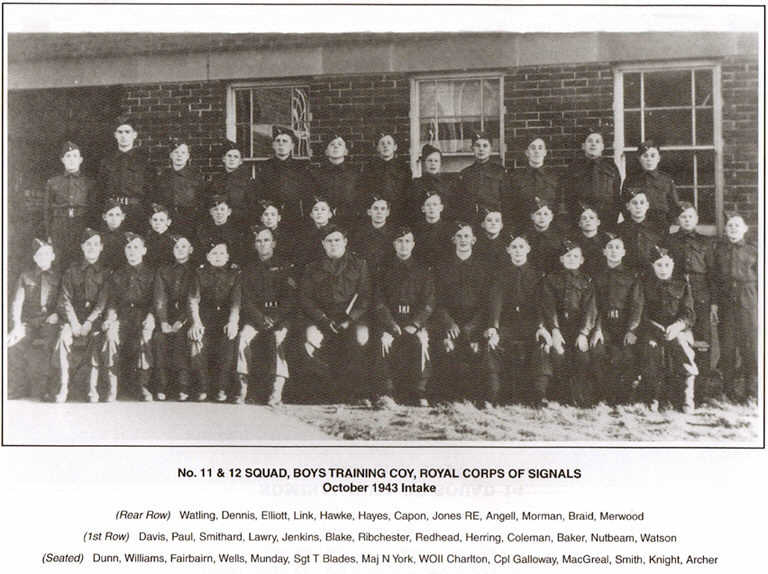
I was searching for information on the above question, the Royal Signals Museum
came up with a photo of Fred at Catterick in
1943. Fred has no recollection of it
being taken but, as he says ‘It was a long time ago’. Very true Fred! |
|
|
|
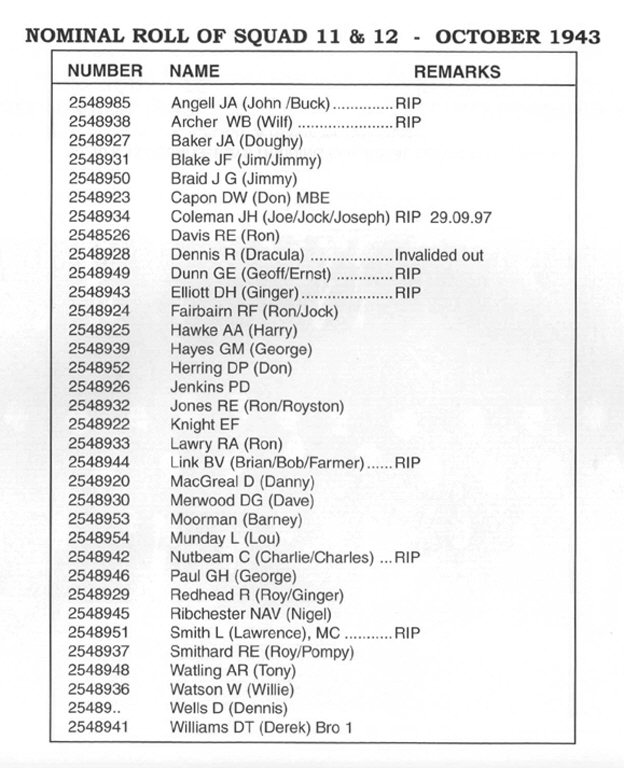
A
big vote of thanks goes to Lt. Col.(Retd.) Mike Butler, a volunteer researcher at the Royal
Signals Museum, for the information he came up with, along with the photo and
squad roll call below. Mike himself
was a Royal Signals apprentice at Catterick,
February 1948 to August 1948. |
|
|
|
|
|
|
|
|
|
The Source and Copyright © Ownership of the above
photographs is The Royal Signals Museum. |
|
|
|
The
following corrections came from Fred…… ‘I think the powers that be have got it wrong regarding the names on the Squad. There are 34 names listed including a D. Wells without the full number. On the photo there are again 34 people including me seated on the front row. There is no D. Wells and I do not remember any other Wells of that intake. The Wells without the full
number is actually probably me as I transferred to Arborfield,
but where they got the D (Dennis) from is unknown.’ |
|
|
|
|
|
First Published: 15th July 2011. Latest Update: 1st August 2011. ___________________________________________________________________________________ |
|
|
|
|
|
|